The company must reject those rods whose diameters lie outside the tolerance range of +/- 0.011 inch as specfied by AISI.
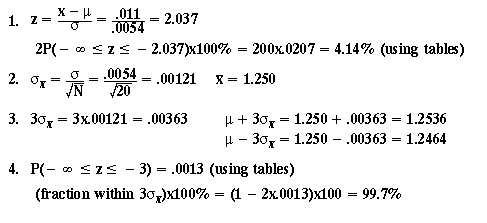
- What percentage must be rejected?
- New readings are taken at a rate of 20 per hour. What would you expect the sample mean and standard deviation of the 20 readings to be if no statistical changes occur?
- During an 8 hour shift sample averages (of 20 readings each) were made as listed in the table below. Check on the table whether each one lies within or outside 3 (sample) standard deviations above or below the expected sample mean.
- What percentage of the sample means are expected to lie within the +/- 3 sigma band.
| Average | within | outside | ||||||
|---|---|---|---|---|---|---|---|---|
| 1.2485 | X | |||||||
| 1.2481 | X | |||||||
| 1.2506 | X | |||||||
| 1.2503 | X | |||||||
| 1.2490 | X | |||||||
| 1.2544 | X
| 1.2553 | X
| 1.2546 | X
| |
Due:Monday, Mar 24 5:30 PM
<= BACK